Flying Knives Multiplication: Hit the Expression That Equals the Target
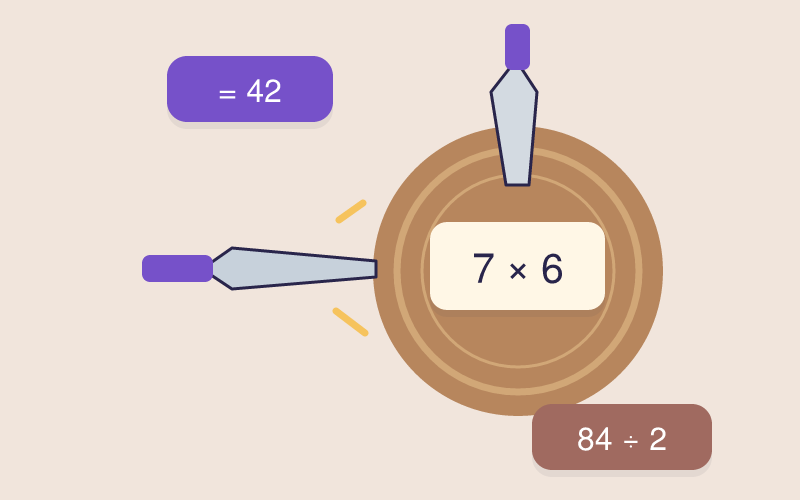
A target result appears and the knife arcs across the screen; release at the right instant to cut the multiplication or division expression whose value matches. Each throw trains you to read an expression by its result, not by its symbols.
Memorizing 6×4 Doesn't Make 24÷6 Automatic — The Knife Makes You Reverse It
Most fourth graders can chant their times tables, yet freeze when the same numbers show up as a division fact — the reversal never got wired in. Flying Knives puts a single target value at the top, then floats several expressions, some multiplication and some division, along the blade's path. Because every correct hit has to equal that one number, students stop reading × and ÷ as separate rules and start seeing 6×4, 24÷6, and 24÷4 as one connected fact family. The timing element forces a real decision: you evaluate before you release, so a lucky guess and an understood answer feel completely different. Missing a throw becomes a prompt to ask which factor or divisor was off, not just to try again.
From Memorized Products to Two-Way Fact Fluency in Grades 4-5
This game builds on the multiplication-division relationship introduced in third grade (CCSS 3.OA.B.6) and the multiplicative comparison thinking of fourth grade (CCSS 4.OA.A.1). Students who can read an expression by its value are ready for factors, multiples, and the multi-digit multiplication and long division that follow. It bridges recall of single facts toward flexibly comparing whole expressions.
Three Multiplication-Division Skills Practiced While Slicing
- Evaluate whether an expression equals the target result.
- Connect multiplication and division inside one fact family.
- Reject near expressions where one factor or divisor has changed.
Three Moves to Slice Correctly: Read, Evaluate, Time
- Read the target result, such as “equals 24”.
- Evaluate each multiplication or division expression.
- Slice when the knife path reaches the matching expression and explain why the distractors do not fit.
Five-Minute Teacher Routine: Turn the Target Result Into Fact-Family Talk
Ask students why the wrong expressions do not fit, not just which one is correct. That discussion is what helps multiplication and division connect conceptually.
Flying Knives Questions Teachers Ask About Mixed Facts
Q: Why is division slow if multiplication facts are memorized?
A: The student may not be reversing the fact family yet. Write one multiplication fact as two division facts before play.
Q: How should missed rounds be reviewed?
A: Ask why the wrong expressions fail, not only which expression is correct. That builds conceptual links.