Ratio Blaster: Clear Every Bomb That Equals the Target Ratio
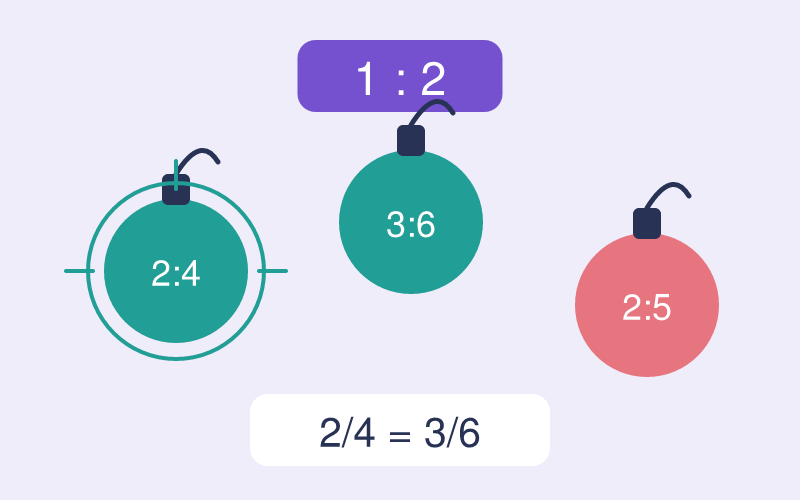
Each round drops a target ratio and a field of ratio bombs, and you tap only the ones that reduce to the same relationship. It trains the leap from grinding out simplifications to seeing equivalence at a glance.
4:6 and 2:3 Look Nothing Alike but Detonate the Same: Scale Beats Guessing
Fifth and sixth graders often stall the instant two ratios share no digits at all — 10:15 sitting beside a 2:3 target reads like a stranger until you divide both terms. Ratio Blaster forces that reduction into a snap decision: the bombs stay on screen, the round keeps moving, and only the pairs that collapse to the target survive your tap. Because a wrong tap on 3:2 costs you, the ordered pairing of first quantity to second stops being a footnote and becomes the thing you check first. Clearing a full field is where scaling up and scaling down stop being written procedures and start reading like a pattern your eye catches instantly.
Where Ratio Calculation Becomes Ratio Recognition (Grades 5-6)
This lands squarely on CCSS 6.RP.A.1, where the ratio relationship itself becomes the object of study, and it leans on the Grade 5 fraction-equivalence work in 5.NF.A.1 that makes 4:6 = 2:3 feel natural. Clearing bombs fluently is the on-ramp to CCSS 6.RP.A.3 — using equivalent ratios and scale factors to reason through unit-rate, percent, and proportion problems.
Three Ratio Skills Practiced While Clearing Bombs
- Simplify each ratio bomb to compare it with the target.
- Recognize equivalent ratios even when the numbers look different.
- Filter distractors quickly while keeping the ratio order correct.
Three Moves to Blast: Read, Simplify, Click
- Read the target ratio and reduce it if needed.
- Inspect each ratio bomb and simplify or compare by a scale factor.
- Click only the bombs that are equivalent to the target ratio.
- Clear every correct bomb to move into the next round.
Five-Minute Teacher Routine: Judge Three Bombs First
Before play, set the target at 2:3 and ask students to judge 4:6, 6:8, and 10:15. Require a simplification or scale-factor reason before the game begins.
Ratio Blaster Questions Teachers Hear
Q: Why does my student mix up 2:3 and 3:2?
A: Ratio order matters. Have students read the ratio as “first quantity to second quantity” so they do not reverse the comparison.
Q: Do students always need to write the greatest common factor?
A: Not always. Early practice can include written simplification, but fluent students may use scale factors. The key is explaining why the ratio matches.