Proportions Fill: Solve for the Missing Term in Every Proportion
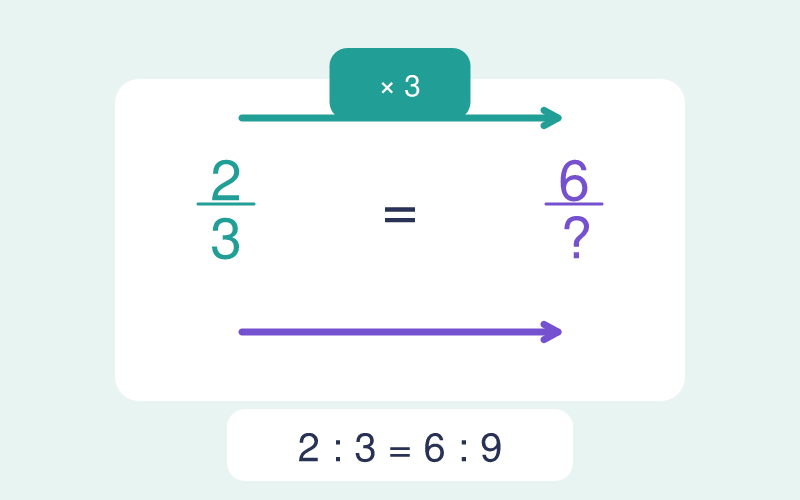
Read a proportion like a:b = c:?, find the scale factor that links the two ratios, and tap the answer that completes it. Each round trains you to see equivalent ratios as one multiplicative relationship, not a cross-multiply trick to memorize.
Why the Missing Left-Side Value Trips Students: Scaling Has to Run Backward
Slide the question mark to the left of the proportion — ?:8 = 6:24 — and the forward habit breaks down: the factor that stretched 6 into 24 now has to run backward, dividing 8 to reach the answer. Grade 6-7 players handle the forward direction fine, multiplying a known term by a factor to land the answer, but they freeze when the blank sits on the left and the same factor must be undone by division. Proportions Fill exposes that gap by placing the question mark in any of the four positions, so a single memorized direction stops working. Because the two ratios sit side by side and the answer buttons force a commitment, students have to name the factor that resizes one ratio into the other before they tap. The hint after each choice replays the multiply-or-divide move, turning a guessed cross product into a relationship you can see. Over a set, the scale factor stops being a rule and becomes the thing you look for first.
Filling One Blank at a Time Ties Grade 6 Equivalent Ratios to Grade 7 Proportional Reasoning
Proportions Fill sits on CCSS 6.RP.A.3, where sixth graders solve ratio and rate problems by reasoning about equivalent ratios, and it opens the door to CCSS 7.RP.A.2, where seventh graders identify and represent proportional relationships. Coming in, players draw on unit-rate and equivalent-ratio thinking; heading out, the game feeds straight into writing and solving proportion equations and, later, the constant of proportionality. Filling one blank at a time keeps the multiplicative relationship in view before symbolic cross-multiplication takes over.
Three Proportion Skills Practiced While Filling the Blank
- Recognize equivalent ratios and decide whether both sides describe the same relationship.
- Use a scale factor to enlarge or shrink corresponding terms consistently.
- Check the missing value with multiplication, division, or a cross-check.
Three Moves to Fill the Proportion: Read, Scale, Choose
- Read the full proportion and notice which position is missing.
- Compare known corresponding terms to find the scale factor.
- Apply that same scale factor to the missing term.
- Choose the answer button and review the hint to confirm the ratios match.
Five-Minute Teacher Routine: Say the Scale Factor First
Require students to say “multiply by” or “divide by” before clicking an answer. If they can name the scale factor, the proportion is being solved through reasoning, not guessing.
Proportions Fill Questions Teachers Hear
Q: Do students have to use cross multiplication?
A: No. Early proportion work is often clearer with scale factors. Once students can explain how both sides scale together, cross multiplication becomes a tool rather than a memorized trick.
Q: Why is a missing value on the left side harder?
A: It often requires working backward with division instead of forward with multiplication. Ask students to state the scale factor in both directions before choosing an answer.