Percent Bingo: Compute a Percent of a Number and Mark the Winning Tile
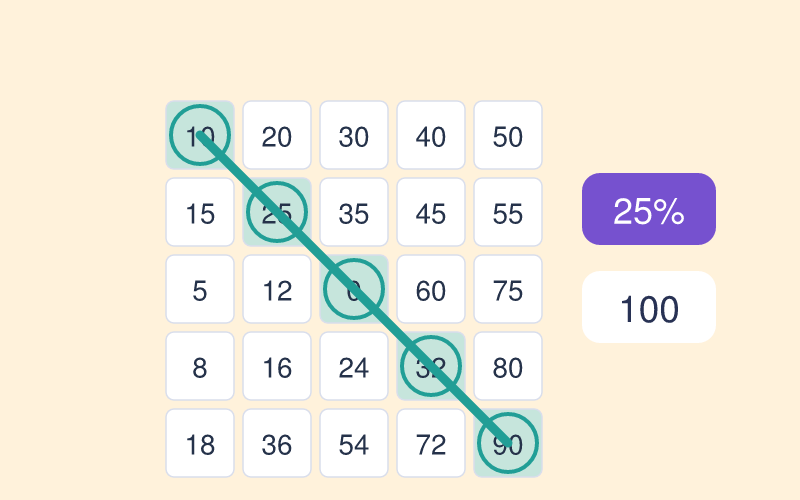
Each prompt names a base and a percent, like 35% of 80; you compute the result and tap its square on the 5-by-5 board. Completing a line rewards students who keep their percent calculations accurate under a steady stream of questions.
Knowing 50% Is Half Doesn't Carry You Through 15% and 35%
Grade 6 learners usually nail 50% as half, then stall the moment a prompt asks for 15% or 35% of a number, because those demand a decomposition like 10% plus 5%. On paper that hesitation stays hidden; on the bingo board it surfaces at once, since a correct tile advances the round while a wrong tap leaves the line unfinished. Because the answer must be located among 25 real numbers, students can't guess loosely — they have to commit to a value they actually computed. Tapping the matching square turns each percent into a concrete target instead of an abstract exercise, and the push to complete a row rewards a repeatable mental strategy over one-off luck.
Percent-of-a-Number Fluency Feeds Discounts, Rates, and Ratio Reasoning
Percent Bingo targets CCSS 6.RP.A.3c, calculating what portion of a quantity a given percent represents, and builds on the equivalent-ratio and unit-rate foundation of 6.RP.A.3. Fluency here feeds straight into everyday percent contexts — discounts, taxes, and tips — and prepares the proportional-relationship work of Grade 7 under 7.RP.A.3. The decomposition habit students rehearse becomes the base for percent increase and decrease later on.
Three Percent Skills Practiced While Marking Tiles
- Interpret percent as a relationship between a part and a whole.
- Calculate common percent-of-a-number results using fraction, decimal, or mental strategies.
- Locate the matching answer tile quickly while maintaining accuracy across repeated questions.
Three Moves to Bingo: Read, Calculate, Mark
- Read the prompt and identify the base number and the percent.
- Convert the percent into a useful fraction or decimal and calculate the result.
- Find the answer in an unmarked tile. A correct answer automatically advances to the next question, and every question has an available answer on the board.
- When a row, column, or diagonal completes, continue from the Bingo message to the next question. Each line scores once; finish all 25 tiles, then start a new game.
Five-Minute Teacher Routine: Warm Up with 10% and 5%
Before play, ask for 10%, 5%, and 15% of 80. Once students can split a percent mentally, the bingo board becomes a useful fluency check.
Percent Bingo Questions Teachers Hear
Q: Why are 15% questions much slower than 50% questions?
A: Students often know that 50% means half, but 15% requires a strategy such as 10% plus 5%. Ask them to name the split they used, not just the answer.
Q: Is this game finding the part, the whole, or the percent?
A: The main task is finding the part when the whole and percent are known. Teachers can extend the round afterward by reversing a prompt and asking for the whole or the percent.