Ratio Match: Flip Cards and Pair Ratios That Reduce to the Same Simplest Form
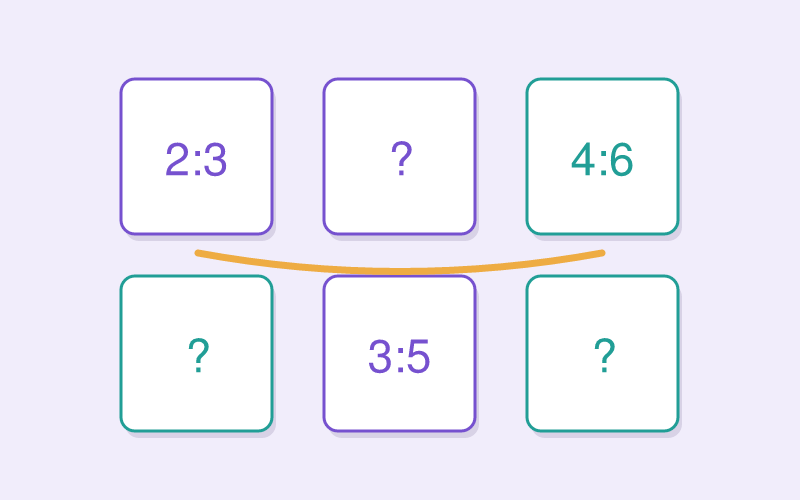
Turn over two ratio cards, simplify each with common factors, and keep the pair only when both collapse to the same ratio. Every flip trains you to read 4:6 and 2:3 as one scaled relationship, not two different numbers.
Same Face, Same Ratio? Reducing Is the Only Way to Know
Most learners stall here because a card showing 4:6 looks nothing like a card showing 2:3, so they never suspect the two belong together. Ratio Match forces the check: before you can claim a pair, you divide each card by its greatest common factor and read off the simplest form underneath. Flipping tiles and holding their positions in memory turns an abstract equivalence rule into a physical hunt for matching cores. When 6:9 and 2:3 finally lock, the scale factor of 3 stops being a formula and becomes something you watched happen. Order still counts, so 3:2 never matches 2:3 — a trap the cards quietly expose.
Building Proportional Reasoning from the Ground Up, Grades 5-7
Ratio Match sits right where ratio reasoning begins, extending fraction equivalence (4.NF.A.1) into ratio language and cementing CCSS 6.RP.A.1 and 6.RP.A.3. The simplifying habit it drills is the same move students later reuse to nail unit rates and percents. Master equivalent ratios here and the proportional relationships of 7.RP.A.2 become a natural next step rather than a new topic.
Three Ratio Skills Practiced While Matching Cards
- Simplify each ratio card with common factors.
- Recognize equivalent relationships even when the numbers are scaled.
- Remember card positions while applying mathematical reasoning.
Three Moves to Match: Flip, Simplify, Compare
- Flip the first ratio card and remember its position.
- Simplify the ratio or identify its scale factor.
- Flip a second card and compare the simplified ratios.
- If the ratios match, keep the pair; if not, remember both locations.
Five-Minute Teacher Routine: Build One Pair with Blocks
Use colored blocks to build 2:3 and 4:6 before play. When students see the same color relationship, simplifying ratios becomes more meaningful.
Ratio Match Questions Teachers Hear
Q: Why do 2:3 and 4:6 match?
A: The ratio 4:6 reduces by 2 to become 2:3, so both describe the same relationship.
Q: Can 3:2 match 2:3?
A: No. Ratio order matters. Reversing the terms changes the comparison.