Pizza Fractions: Count Slices to Name and Compare Fractions
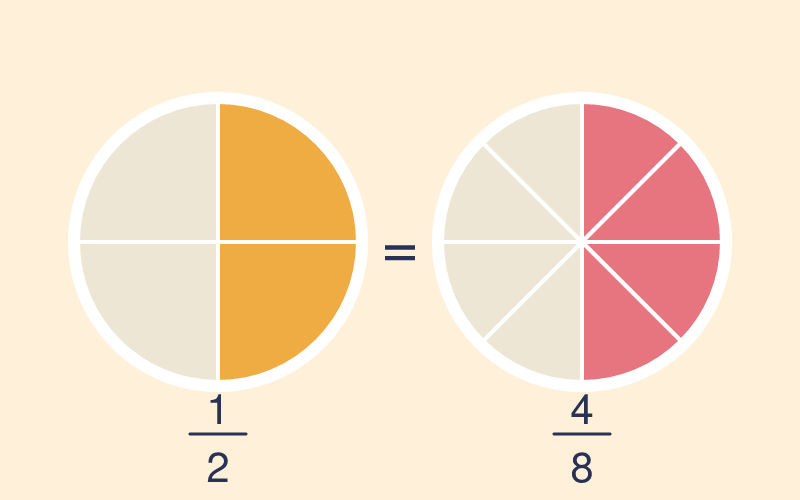
Read how one pizza is split, tap the topping slices, and build the fraction card that matches. Each round turns the belief that a bigger denominator means more into something you can actually see and rank.
Cutting a Pizza Into More Pieces Makes Each Piece Smaller
Students usually stall the first time 1/8 looks smaller than 1/4 — the digit 8 beats 4, so the fraction 'should' be bigger too. Pizza Fractions breaks that habit by keeping one whole pizza on screen and re-slicing it: split the whole into 4 or 8 equal wedges and the shrinking wedge is impossible to miss. You count topped slices for the numerator and total slices for the denominator, so both numbers stay tied to the same circle of dough. When you pick a fraction card, the game checks it against the visible area, not just the symbols, so a wrong guess sends you back to re-count instead of rereading a rule.
From Naming Equal Parts in Grade 3 to Comparing Them in Grade 4
Grade 3 first defines a fraction as equal parts of one whole (3.NF.A.1) and asks students to reason about its size on that same whole (3.NF.A.3) — exactly the two moves each pizza round demands. Comparing topping area then carries straight into Grade 4 equivalence and common denominators (4.NF.A.1), the bridge learners cross before they add, subtract, and multiply fractions.
Three Fraction Skills Practiced With Pizza Slices
- Identify the denominator by counting equal slices in the whole pizza.
- Determine the numerator by counting topped slices.
- Compare fraction size by looking at area within the same whole.
Three Moves to Choose the Fraction: Whole, Toppings, Card
- Check how many equal slices make the whole pizza.
- Count how many slices have toppings.
- Put topped slices in the numerator and total slices in the denominator.
- Choose the fraction card that matches the pizza picture.
Five-Minute Teacher Routine: Cut Paper Pizza First
Pair the game with paper circles or hand-drawn pizzas. When students physically split the whole and then match it to the screen, fraction comparison becomes much more intuitive.
Pizza Fractions Questions Teachers Hear
Q: Why does my student think 1/8 is larger than 1/4?
A: They may be comparing denominator digits instead of slice size. Show that cutting the same pizza into more pieces makes each piece smaller.
Q: Can this support equivalent fractions?
A: Yes. After play, draw pizzas for 1/2, 2/4, and 4/8 and compare the topping area.