Kitten Match: Flip Cards to Pair Every Sum With Its Equal Answer
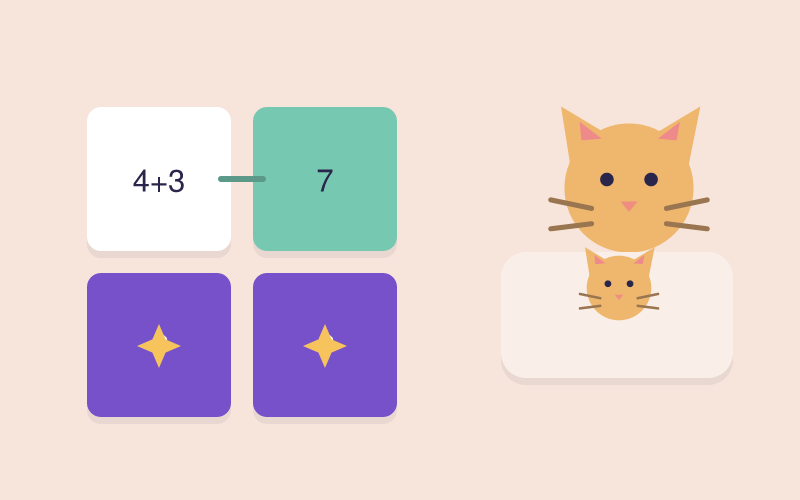
Tap two kitten cards on the memory grid and decide whether an addition fact and a number point to the same value. Every turn trains fact recall and the idea that different expressions can name one number.
Why Do Kids Who Nail 8+5 Freeze When 13 Sits Face-Down Two Cards Away?
Most Grade 1-2 players can add 8+5 in isolation, yet freeze when a face-down grid asks them to link that fact to the number 13 sitting two cards away. The stall is not the arithmetic; it is holding an expression and its value in mind at the same time. Because every flip reveals either an addition fact or a bare answer, a match only closes when a child treats 8+5 and 13 as the same quantity rather than two unrelated cards. Turning that mental equality into a real pairing move gives the abstract equal sign a shape a child can point at and flip over.
First and Second Graders Move From Adding a Single Fact to Spotting Equal Expressions
This bridges the shift 1.OA.D.7 asks for — reading the equal sign as "the same value" — toward 2.OA.B.2 fluency with sums and differences within 20. Children who already recall single facts start noticing that 7+6, 8+5, and 13 share one value, the same reasoning that later supports missing-addend equations and mental regrouping strategies.
Three Skills Practiced While Flipping Kitten Cards
- Recognize the expression on a kitten card: turn facts such as 7+6 and 8+5 into values more quickly.
- Match the correct answer pair: connect an expression with an equivalent number instead of guessing by position alone.
- Hold the memory-grid information: track card locations and math relationships at the same time, strengthening working memory and fact Fluency.
Three Moves in the Memory Grid: Flip, Solve, Match
- Flip two kitten cards in the memory grid and read the expression or answer on each card.
- If the expression value and answer pair match, the cards stay open; if not, remember their positions and try again.
- Clear the board by matching every kitten card with its equivalent answer pair.
- For stronger practice, explain why each successful pair is equal before flipping the next cards.
Five-Minute Teacher Routine: Turn Missed Kitten Cards into Equality Talk
Track two pairs the student misses repeatedly, then write those expressions on paper after play. Ask which cards make a pair and why. When students can justify the answer pair with an addition fact, the memory grid has become equality practice rather than only a recall game.
Kitten Match Questions Teachers Ask About Memory and Math
Q: Is my student just memorizing positions instead of practicing math?
A: Position memory is part of the game, but each turn still requires deciding whether an expression and answer are equivalent. Ask the student to say the full match aloud, such as 8+5 equals 13. If they can explain the equality, the math is doing real work.
Q: How can I use Kitten Match for addition fact review?
A: Write four target answers on the board first, such as 10, 11, 12, and 13, and ask students for two expressions that match each answer. Then play one round. Afterward, revisit two missed pairs and discuss why they did or did not match.