Addition Puzzle: Peel Every Tile by Recalling Sums Within 20
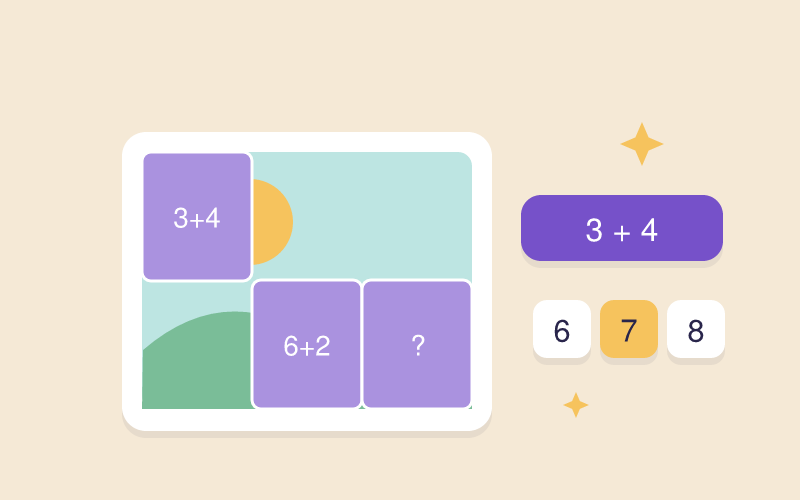
Answer each addition fact and one puzzle tile drops away from a hidden picture. The pull to reveal what's underneath keeps young learners retrieving sums fast enough to make recall automatic.
Getting It Right Isn't the Problem — Getting It Fast Is
The wall here is not comprehension: most K–Grade 2 kids can figure out 8+5, they just fall back to counting on fingers instead of pulling the answer straight from memory. On a worksheet that slow retrieval hides, because every box eventually gets filled in. Addition Puzzle makes it visible and rewarding instead — each correct tap knocks one tile off a mystery picture, so children rush to solve the next fact just to see more of the image. A wrong pick only flashes red and lets them retry, so the pressure stays gentle while the reps pile up. Twelve to twenty tiles per board is exactly enough repetition to start converting 'figured out' into 'just known.'
Kindergarten to Grade 2: Turning Addition Facts Into Instant Recall
This sits right on CCSS 1.OA.C.6 — fluently add and subtract within 20 — and reinforces the K.OA.A.5 target of fluency within 5 that comes just before it. The automatic recall it builds is the launch pad for 2.OA.B.2 (fluency within 20 from memory) and for the two-digit place-value addition of 2.NBT.B.5. Learners who can pull these sums without counting free up working memory for the multi-step word problems that follow.
What's Hiding Behind Every Puzzle Tile? Three Math Muscles Trained Within 20
- Retrieve the addition fact hiding under each puzzle tile: shift students from finger-counting to instant recall on basic facts within 20, the foundation of later mental math.
- Hold accuracy under the gentle pressure of an unfolding mystery picture: train fluency without the timed-test anxiety that often makes Grade 1 students rush and misclick.
- Anchor number sense around the hardest combinations (8+5, 7+6, 9+4): repeated exposure turns these high-frequency facts into stable conceptual understanding rather than memorized chants.
Three Steps from the First Puzzle Tile to the Full Picture
- An addition fact within 20 appears center-screen, with three or four number cards as answer choices below.
- Click or tap the correct card. Correct answers knock one puzzle tile loose from the mystery picture above; wrong picks flash red and let the student retry without penalty.
- Once every puzzle tile is gone and the mystery picture is fully visible, the round ends. Students can load a fresh picture or check the accuracy summary before stopping.
Teacher Five-Minute Routine: Treat Every Mystery Picture as a Fact Activator
List the three to five addition facts the student still hesitates on (usually around 8+something or 7+something). After a mystery picture round, run those exact facts as a quick oral check. If their recall is noticeably faster than before play, the puzzle reps activated that fact set and the class is ready to move on; if the pause is still there, queue another round.
Two Questions Parents and Teachers Keep Asking About "Knows It, Just Slowly"
Q: My first-grader gets every addition fact right at home but freezes on the timed quiz — will Addition Puzzle actually help?
A: That gap is a retrieval issue, not a comprehension issue. Addition Puzzle gives the same student two to three times more reps in a five-minute window than a paper drill, because peeling each puzzle tile motivates them to keep going. Run a one-minute paper quiz before and after a three-day stretch of play and the speed difference on facts within 20 is usually visible.
Q: How can a Grade 1 teacher slot this into a math warm-up or center rotation?
A: Use it as a five-minute opener or a station during math centers. Have students do six "8 plus something" and "7 plus something" facts on paper first — those are the combinations most learners stall on — then let one student play a single mystery picture round. Re-ask the same six facts orally afterward. Faster recall means the retrieval rep landed; slow recall means the group needs another round before moving into the new lesson.