Number Bonds 20: Pair Every Bubble Into a Complete 20
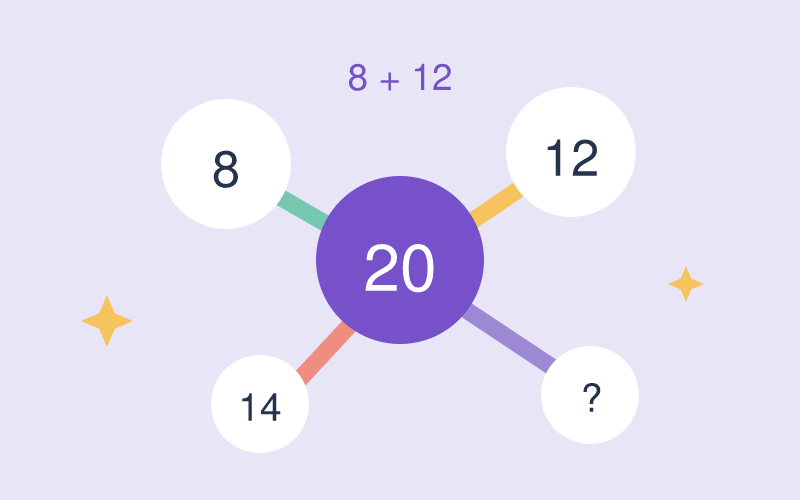
Ten numbered bubbles float on screen; grab one, hunt down the partner that completes 20, and clear all five pairs before the timer runs out. Each match rebuilds 20 as a whole made of two known parts.
Counting to 20 Every Time Is the Bottleneck a Partner Card Removes
Most first graders can find 13 + 7, but only by counting 14, 15, 16 all the way up — so 20 never settles into a fixed shape in their heads. This game stalls that habit on purpose: the moment you hold the 13 bubble, the only useful question becomes "how far to 20?", not "what comes next?". Because both cards snap into a shared 20-frame the instant they pair, the missing 7 stops being a counting result and becomes a remembered partner. Over a 60-second round the same friends — 11 with 9, 12 with 8, 13 with 7 — surface again and again until the decomposition is automatic. That repetition is what turns a slow count into instant recall of the bond.
Make-20 Pairs Are the Grade 1-2 Bridge Into Regrouping
Number Bonds 20 sits right after counting within 20 and just before the make-ten and regrouping strategies of second grade, matching first-grade fluency standard 1.OA.C.6, then extending into 2.OA.B.2 as second grade begins. Students who own these pairs read 8 + 7 as "fill the ten, then two more" instead of counting up from eight, and they solve missing-addend problems like 13 + □ = 20 on sight. The same part-whole picture later scaffolds subtraction within 20 and early place-value reasoning about tens and ones.
Three Decisions in Each Match
- Calculate the complement: subtract the first bubble’s value from 20.
- Distinguish values from bubbles: equal values still need two different bubbles.
- Check the sum: after an incorrect choice, add the two values again before selecting another pair.
Steps and completion rules
- Select a numbered bubble and work out how much it needs to reach 20.
- Click a different bubble to form a pair. A correct match clears; after an incorrect match, wait for the red feedback to end and choose again.
- Find all five pairs within 60 seconds. Review the pair count at the end and choose Play again to restart.
Teaching Prompt: Say the Complement Before Tapping
Before clicking, say “20 minus this number equals what?” After play, ask a few pairs away from the screen. Use the explanation and incorrect matches to decide which combinations need more practice.
Bubble Matching Questions
Q: What happens after an incorrect match?
A: Both bubbles briefly turn red and become available again when the feedback ends. The pair count does not increase, and the timer continues.
Q: What changes when I play again?
A: Replay restores 60 seconds, selects five make-20 pairs again, and rearranges their bubbles. Do not rely on positions from the previous round.
Q: How can I explain a matching pair?
A: For example, 13+7=20, so 20−13=7. State that relationship before selecting the two bubbles.