Number Pairs 10: Match Every Bubble Pair That Sums to Ten
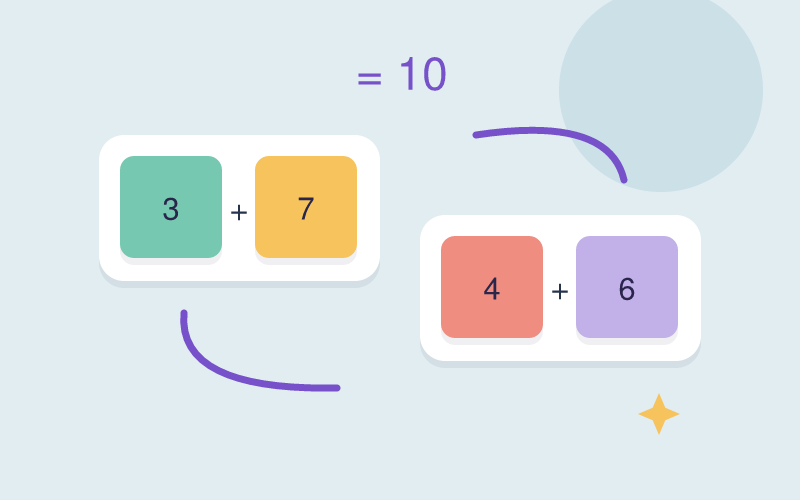
Tap two of the ten numbered bubbles to test whether they make ten, then clear all five pairs before the 50-second timer stops. Each round rebuilds the part-whole habit that turns counting-on into instant recall.
Why Does a Lone 8 Send Kids Back to Finger-Counting Instead of Recalling Its Ten-Partner?
Most kindergartners can count out 6+4, yet hand them a lone 8 and they slide back to finger-counting instead of asking how far it sits from ten. Number Pairs 10 forces that missing-part question onto every tap: pick one bubble, and the board silently dares you to find the partner that fills the ten-frame. Because a wrong pairing is rejected the instant you tap the second bubble, students get immediate feedback on the guess rather than a delayed worksheet mark. Replaying reshuffles the ten bubbles, so success depends on the relationship 3 pairs with 7, not on a memorized screen position. Over a few 50-second rounds the five anchor pairs stop being sums to compute and start being facts students subitize.
Kindergarten to Grade 1: Growing Make-Ten Fluency Before Regrouping Arrives
Kindergartners begin by counting to ten (K.CC), then take the harder step of naming which number partners with another to reach ten, exactly what CCSS K.OA.A.4 asks for. The five make-ten pairs drilled here become the backbone of adding and subtracting within 20 in 1.OA.C.6; they also preview the regrouping trick students lean on for 8+7 and 13-6. Lock these bonds in now, and place value plus two-digit addition in Grade 2 arrive with far fewer finger-counts.
Three Decisions in Each Match
- Calculate the complement: subtract the first bubble’s value from 10.
- Distinguish values from bubbles: equal values still need two different bubbles.
- Check the sum: after an incorrect choice, add the two values again before selecting another pair.
Steps and completion rules
- Select a numbered bubble and work out how much it needs to reach 10.
- Click a different bubble to form a pair. A correct match clears; after an incorrect match, wait for the red feedback to end and choose again.
- Find all five pairs within 50 seconds. Review the pair count at the end and choose Play again to restart.
Teaching Prompt: Say the Complement Before Tapping
Before clicking, say “10 minus this number equals what?” After play, ask a few pairs away from the screen. Use the explanation and incorrect matches to decide which combinations need more practice.
Bubble Matching Questions
Q: What happens after an incorrect match?
A: Both bubbles briefly turn red and become available again when the feedback ends. The pair count does not increase, and the timer continues.
Q: What changes when I play again?
A: Replay restores 50 seconds and rearranges the ten bubbles. The five pairs remain 1+9, 2+8, 3+7, 4+6, and 5+5.
Q: How can I explain a matching pair?
A: For example, 7+3=10, so 10−7=3. State that relationship before selecting the two bubbles.