Number Patterns: Find the Step and Place the Missing Tile
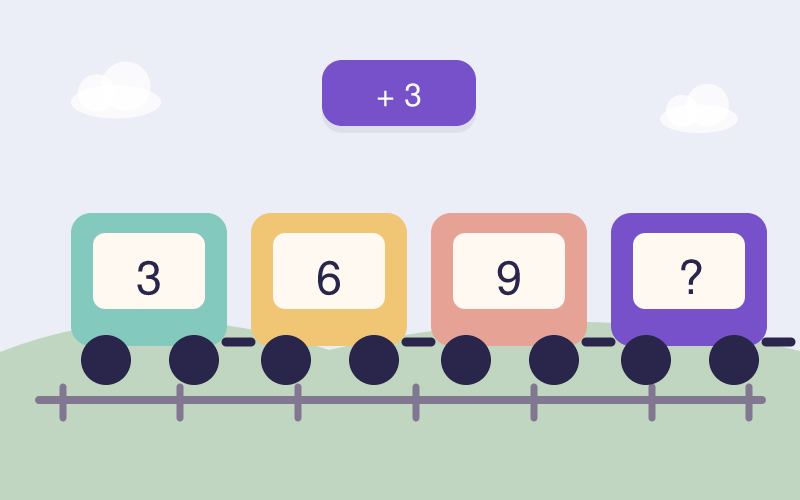
Read a sequence track with one empty slot, weigh the tiles on either side, and drop in the number that keeps the pattern going. It trains children to look for a rule across several numbers instead of guessing each blank on its own.
Guessing the Blank Stalls; Reading the Gap Between Tiles Solves It
Most Grade 2-3 students meet a sequence and jump straight to the empty slot, trying numbers until one feels right. The real work sits in the gaps: the jump between 6, 9, and 12 is the rule, not the tiles themselves. Number Patterns lays the whole track in view so a child can scan each neighboring pair, tap out the constant step, and watch it repeat. Because a tile only clicks into place when it honors that step, a lucky guess and a reasoned answer stop feeling the same. The interaction quietly pushes learners from calculating one fact to describing how an entire row grows.
Grades 2-3: Turning Skip Counts into Stated Arithmetic Rules
Repeated addition and skip counting (CCSS 2.NBT.A.2) are exactly where a sequence stops being a loose list and starts being a rule. Once a second or third grader can say the step aloud, they are already reaching toward identifying arithmetic patterns (standard 3.OA.D.9), and from there into multiplication tables and input-output machines. Fluency with add-and-subtract within 100 is what makes this click; explaining why a rule must hold is the door it opens next.
Three Pattern Skills Built While Placing Number Tiles
- Observe both sides of the sequence track: compare neighboring numbers before guessing the blank.
- Infer the missing number tile: use fixed addition, subtraction, skip counting, or a repeated change to complete the pattern.
- Verify the full sequence: read the whole track again and check that every step follows the same rule.
Three Moves on the Sequence Track: Compare, Place, Check
- Read the visible number tiles from left to right and compare neighboring values.
- Find the step size or repeated change, then choose the missing number tile.
- Submit the answer and reread the sequence to confirm that the same rule still works.
- For stronger practice, say the rule aloud before selecting the tile.
Five-Minute Teacher Routine: Turn Missing Tiles into Rule Talk
After one round, ask students to invent a five-term sequence and remove one tile for a partner to solve. Creating a stable pattern is a stronger check of understanding than filling one blank correctly.
Number Patterns Questions Teachers Hear About Missing Terms
Q: Why does my student know arithmetic but still struggle with sequences?
A: A sequence asks students to notice a relationship across several numbers, not just calculate one answer. Number Patterns keeps the track visible so learners compare neighboring tiles and identify the rule before placing the missing number.
Q: How can I tell whether a student understood the rule or guessed?
A: Ask the student to state the rule after the answer: add 3 each time, count by 5s, or subtract 2 each step. If they cannot describe the change, return to the sequence track and compare the visible numbers again.