Fraction Forest: Shade Bars Until Equal Fractions Line Up
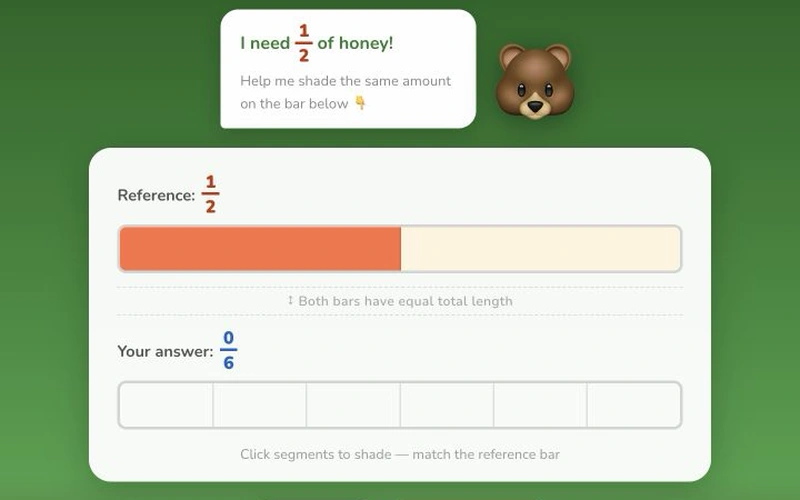
Read a target fraction, then tap the blocks that shade the matching parts of the bar. Comparing two shaded rows turns "which is bigger" into something students can see instead of guess.
Same Whole, Different Slices: Why 2/4 and 1/2 Stop Looking Different
Most students can write 2/4 and 1/2 long before they believe the two are the same size; the denominators look bigger, so the fraction feels bigger. The forest grid interrupts that guess by keeping every bar the same total length while you tap to shade parts. Shade two of four blocks in one bar and one of two in another, and the colored regions end up exactly even, so the eye settles the argument the symbols could not. Because you partition the same whole each time, the question quietly shifts from "which number is larger" to "how much of the bar is covered." That is the pivot equivalence depends on.
Grades 3-5: Building Equivalence Before Common Denominators
Fraction Forest sits right after students first meet a fraction as part of a whole (CCSS 3.NF.A.1) and drives the equivalence reasoning of 3.NF.A.3, where visual models justify why 1/2 and 2/4 name the same amount. Mastering the shaded-length comparison here is the groundwork for 4.NF.A.1's more formal equivalence and, later, the common denominators that rational-number arithmetic requires.
Three Fraction Muscles Trained While Coloring Forest Bars
- Align the full fraction bar first: students check that the whole stays the same before judging numerator or denominator size, which protects Number Sense.
- Shade the matching colored blocks: 1/2, 2/4, and 3/6 become visible lengths, building Conceptual Understanding of equivalent fractions.
- Compare two forest rows side by side: students connect visual length with symbolic fraction language before moving toward fraction Fluency on paper.
Three Moves Through the Forest: Read, Shade, Compare
- Read the target fraction and look at how many equal parts the forest bar has.
- Click or tap the colored blocks that match the numerator while keeping the same whole in view.
- Submit the model and compare the feedback. Equal shaded lengths show equivalence; mismatched lengths send students back to the whole.
- Teacher tip: ask students to say why two bars match before loading the next round.
Five-Minute Teacher Routine: Turn Two Forest Bars Into Talk
After one round, pause before the next problem. Have students draw two equal-length bars, split one into 2 parts and one into 4 parts, then shade 1/2 and 2/4. The check is the explanation: if they can say why the shaded lengths match, the equivalent-fraction idea is ready to travel beyond the screen.
Fraction Forest Questions Teachers Hear During Bar-Model Lessons
Q: Why does my student think 1/4 is larger than 1/2?
A: That usually means the student is reading the denominator as a regular whole number instead of a count of equal parts. Fraction Forest keeps the fraction bar visible while students shade the blocks, so 1/4 clearly covers less of the same whole than 1/2. Ask the student to trace the shaded length with a finger before choosing an answer.
Q: Can Fraction Forest work as a math-center activity for equivalent fractions?
A: Yes. Set it up after a short mini-lesson on equal wholes, then ask students to record one matched pair such as 1/2 and 2/4 in a notebook. The forest bar gives the visual evidence; the notebook sentence turns that evidence into fraction language. That makes the center useful for formative assessment, not just extra screen time.