Pyramid Sum: Subtract From the Apex to Recover a Missing Brick
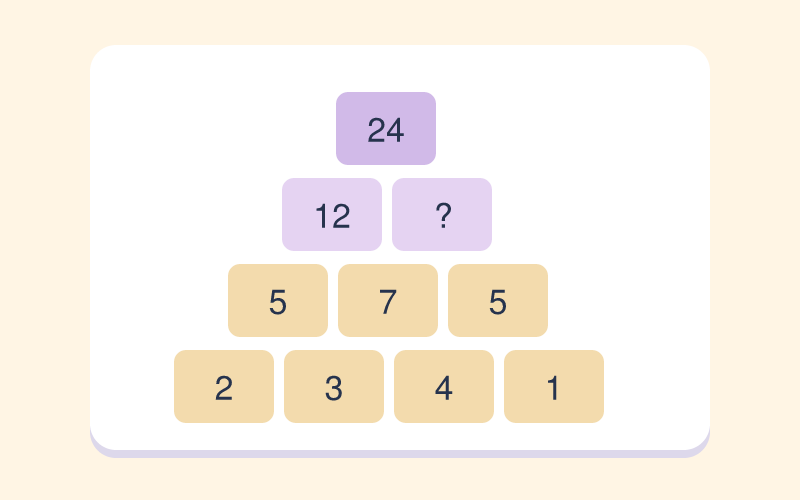
When the apex is known and a base cell is blank, subtract the visible brick from the total above to recover the hidden one—then add it back to check. Each puzzle makes subtraction the key that unlocks the stack.
A Given Apex Won't Let You Add — the Blank Base Brick Only Surfaces by Subtracting
Students who are comfortable combining two bricks freeze the moment a puzzle hands them the apex and leaves a base brick empty: there is nothing to add, because only one of the two base values is showing. The apex already promised to be the total of its two bricks, so the whole is known and one part is known—the hidden part has to be pried out. Take an apex of 15 sitting over a base brick of 9 and a blank beside it: the blank is 15 − 9 = 6, and 6 + 9 checks straight back to 15. Choosing subtraction here is not a guess; once the total is fixed, subtracting the visible part is the single operation that isolates the unknown part. That is why a filled-in top, not a filled-in base, is the cue to turn the arrow around and subtract.
Why 'Subtract to Recover a Missing Part' Keeps Paying Off From Grade 3 to Grade 5
The move rests on the part–part–whole sense students build in Grade 2 (2.OA.B.2, 2.NBT.B.5), where a known total and one known part already point to the missing part. Here that idea becomes deliberate inverse work: recovering a hidden base brick with subtraction is the same reasoning 3.OA.D.8 asks for when a two-step problem leaves an unknown, while clean differences like 15 − 9 lean on the within-1000 fluency of 3.NBT.A.2 before the multi-digit subtraction of 4.NBT.B.4. The habit of asking 'total minus the part I can see' is exactly what later grows into solving for an unknown term in early algebra.
Three Skills Practiced in Pyramid Sum
- adding neighboring values to build the next level
- subtracting a known part from a total
- checking consistency across several connected levels
Teacher and Parent Note
Ask the student to draw arrows showing which two lower cells feed each upper cell. For a backward step, have them state the related addition fact before writing the subtraction equation.