Triangle Sum: Fill the Sides So Every Edge Shares One Total
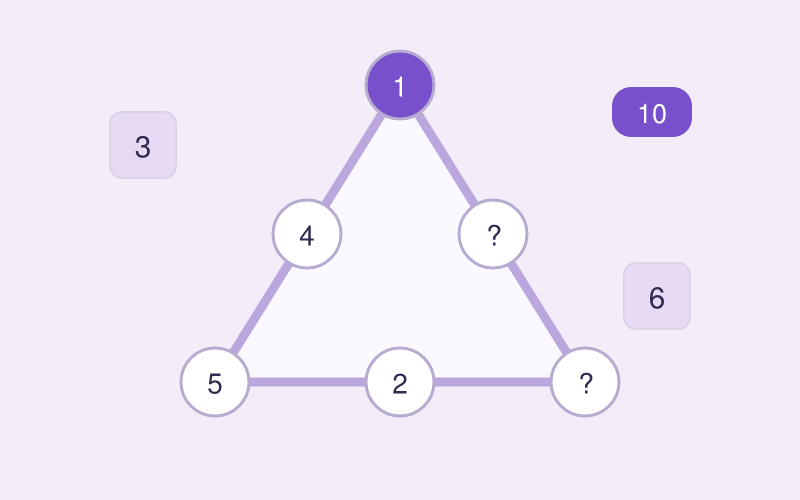
Drag the leftover numbers into the open corners while a few values stay locked in place. Each move trains you to reason from known totals instead of guessing your way around the triangle.
Read the Locked Corners First — They Already Fix Each Edge's Gap
Because a few corners are locked before your first move, it is tempting to grab any leftover number and drop it on the nearest open edge — and then the third side stubbornly misses the target. The locked corners are really the answer in disguise. Aiming for a shared side total of 9 with corners locked at 1, 2, and 3, the edge between 2 and 3 can only take 9 − 2 − 3 = 4, the edge between 1 and 3 can only take 9 − 1 − 3 = 5, and the edge between 1 and 2 can only take 9 − 1 − 2 = 6. Not one of those midpoints is a choice; the fixed corners already decided them. Because you drag each number into place, you feel the difference between hunting for an arrangement and reading what the locked values demand. The shared total is a sum constraint, not a suggestion: you work backward from the locked corners to deduce the single gap each edge still needs, fill in 4, 5, and 6, then cross-check that all three edges balance to that one total.
Grades 4–6: When a Locked Corner Turns an Unknown Into Plain Subtraction
This puzzle sits between the multi-digit fluency of Grade 4 and the equation reasoning of Grade 6. Adding and subtracting whole numbers and recovering a missing addend (4.NBT.B.4, 4.OA.A.3) is the everyday skill, but the locked corners raise the stakes: once a target total and the fixed values are set, an open edge is not a slot to explore — it is a single number you subtract your way to. That is exactly the move behind 6.EE.B.7, where a constrained unknown has one value that makes the equation true. Reasoning from locked slots back to each forced edge is a concrete bridge from arithmetic facts to early algebraic thinking.
Three Skills Practiced in Triangle Sum
- target sums on three connected sides
- finding missing addends from known totals
- eliminating positions with shared-node constraints
Teacher and Parent Note
Have the student write how much each side still needs before moving a value. For every placement, ask them to explain why it works for both sides touching that position.