24-Point Card Game: Solo, Computer, and Two-Player Buzzer Modes
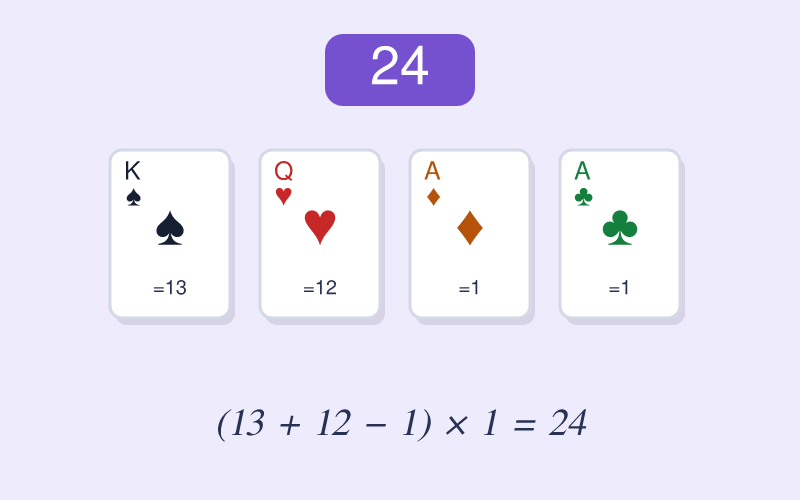
Choose Solo Practice, Vs Computer, or same-device Two-Player Buzzer. Read A, J, Q, and K as 1, 11, 12, and 13; duel players get 15 seconds after buzzing.
Three Modes Share Four-Color Cards and Non-Negative Integer Rules
The game uses a standard 52-card deck with no jokers. A = 1, J = 11, Q = 12, and K = 13; spades are black, hearts red, diamonds orange, and clubs green. Every operation must produce a non-negative integer. Division drops the remainder, so 8 ÷ 5 = 1; a move that would produce a negative result is invalid, and division by zero is never allowed. Solo Practice serves hands verified as solvable under these integer rules and keeps undo, hints, and answers. Vs Computer and same-device Two-Player Buzzer deal random hands, so a round may be unsolvable. After buzzing, a player has 15 seconds to finish. A correct result earns 1 point; a wrong result or timeout loses 1 point and reopens the buzzers. A correct no-solution call earns 1 point and advances, while an incorrect call loses 1 point. Every mode uses all four original cards exactly once.
Expression Planning Starts Here: Fifth-Grade Grouping to Sixth-Grade Order of Operations
The game builds on fourth-grade multi-step arithmetic and formalizes CCSS 5.OA.A.1, where parentheses and grouping symbols change what an expression evaluates to. Choosing which pair to combine first is exactly the order-of-operations reasoning that CCSS 6.EE.A.2 later asks students to read and write as algebraic expressions. Truncated integer division also asks students to reason about how a quotient and discarded remainder change later moves.
Three Strategy Skills Practiced in the 24-Point Card Game
- Read playing-card values by treating A as 1 and J, Q, K as 11, 12, 13.
- Select operators that move the intermediate result closer to the target number.
- Adjust grouping and compare routes when integer division drops a remainder.
Four Steps From Mode Selection to a Completed Round
- Choose Solo Practice, Vs Computer, or same-device Two-Player Buzzer.
- Read the four color-coded cards and convert A, J, Q, and K to 1, 11, 12, and 13.
- Combine cards with +, −, ×, or ÷ while keeping every result non-negative and integral; 8 ÷ 5 becomes 1.
- In a duel, buzz first, then make 24 or call no solution before the 15-second clock ends.
Five-Minute Teacher Routine: Read the Hand, Then Run a Shared-Device Buzzer Round
Ask two students to state all four point values, especially A=1 and J=11, Q=12, K=13. State the integer rule before play: 8 ÷ 5 becomes 1, and negative results are invalid. Switch to Two-Player Buzzer and require the winner of each buzz to explain every step within 15 seconds. After a wrong result or timeout, reopen the same hand. For an unsolvable hand, require a reason based on the same integer rules rather than a guess.
Common 24-Point Card Game Questions About Ranks and Strategy
Q: What changes between the three modes?
A: Solo Practice uses solvable hands and offers hints. Vs Computer races a delayed machine opponent. Two-Player Buzzer puts two large buzzers on the same device. Every match lasts eight rounds.
Q: How does two-player scoring work?
A: The first player to buzz gets 15 seconds. Making 24 or correctly calling no solution earns 1 point. A wrong result, timeout, or false no-solution call loses 1 point, then both players may buzz again.
Q: What are A, J, Q, and K worth?
A: A is 1 point, J is 11, Q is 12, and K is 13. The suit identifies the playing card but does not change its point value.
Q: How do division and negative results work?
A: Every result must be a non-negative integer. Division drops the remainder, so 8 ÷ 5 = 1. A move that would produce a negative result is not allowed, and neither is division by zero.
Q: Why does reaching 24 with cards left not finish the puzzle?
A: All four original cards must be used exactly once. You finish only when one result remains and it equals 24.
Q: Do hints and solutions affect the score?
A: Yes. Using a hint or revealing a solution marks that puzzle as assisted and excludes it from the independently solved count. Resetting the same puzzle does not erase its help history.
Q: How do I stop students from guessing randomly?
A: Ask for the first move before they start: which two cards and which operator? A named first move turns the puzzle into a strategy task.
Q: Is this mostly a calculation-speed game?
A: No. Calculation matters, but the deeper skill is expression planning: deciding what to do first, why that path helps, and how to revise when it fails.