Money Counts: Total the Coins and Bills, Then Make Change
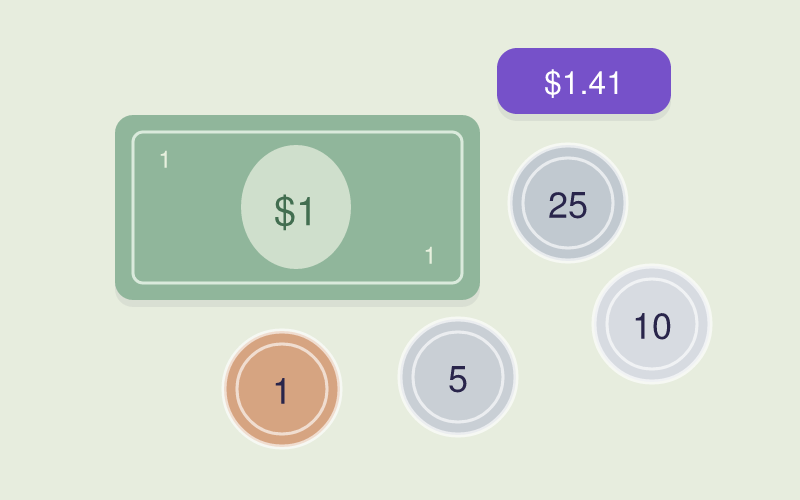
Read a pile of US coins and bills, tap the amount tag that matches their total, then work backward on the change tray. It trains value-based counting and reverse subtraction inside a real shopping scene.
One Quarter Outweighs Three Pennies: Why Counting Pieces Fails
Students stall the moment a Quarter, a Dime, and a Nickel land side by side: they count three coins and answer 3, or add the face numbers without weighting each by its worth. Money Counts forces the value view, because every coin shows its amount and the tag only lights up when you total 25 + 10 + 5 rather than the number of pieces. The later change-tray rounds flip the operation, asking you to subtract the total from the payment and pick the coins that fill the gap. With every value parked on screen for comparison, the abstract jump from 'how many coins' to 'how much money' becomes a concrete choice your finger can act on.
Building Dollar-and-Cent Fluency on Grade 2-3 Addition Facts
Money Counts assumes students can already add and subtract within 100, the fluency behind 2.OA.B.2, then applies it to mixed dollar-and-cent values under CCSS 2.MD.C.8. The change-tray rounds preview subtraction-as-difference thinking, which later powers Grade 3 work on decimal money plus multi-step word problems (3.OA.D.8).
Three Money Skills Practiced in Each Round
- Identify coins and bills by value, including 1¢, 5¢, 10¢, 25¢, and $1.
- Add mixed values to match the amount tag.
- Calculate change by subtracting the total from the payment amount.
Three Moves to Count Money: Name, Total, Change
- Look at the coins and bills and name each value.
- Add from the largest value to the smallest to find the total amount.
- Choose the answer that matches the amount tag.
- For change rounds, subtract the total from the payment amount and choose the change tray value.
Five-Minute Teacher Routine: Build the Amount Before Playing
Use real or pretend coins before the game and challenge students to build a target amount. Once the values feel physical, the on-screen tasks make much more sense.
Money Counting Questions Teachers Hear
Q: Why does my student count the coins but miss the amount?
A: They may be counting objects instead of values. Have them say each value aloud, such as 25 cents plus 10 cents, not just another coin.
Q: Why are change problems harder than total problems?
A: Change requires reverse thinking from the payment amount. Start with physical coins that build up to the payment, then move to mental subtraction.