Sum 31 Grid: Trade Cards Until Every Row and Column Hits 31
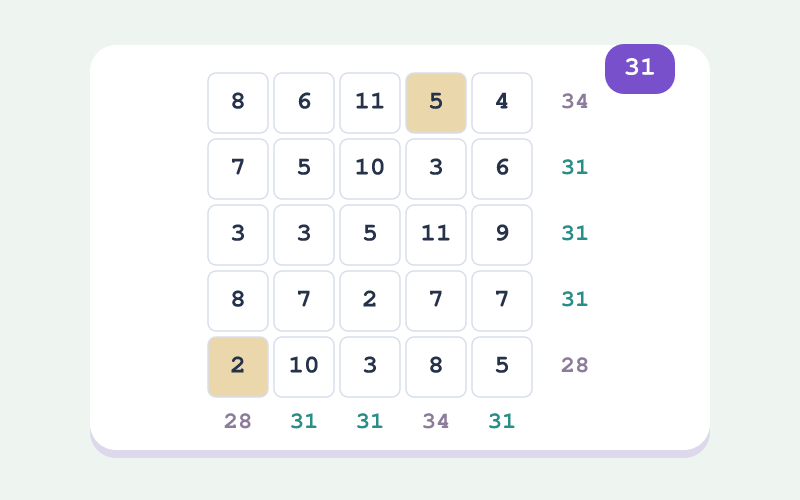
The target remains 31 while each run changes the actual number multiset and starting layout.
Students Who Fix One Row Forget Each Card Also Belongs to a Column
The target remains 31 while each run changes the actual number multiset and starting layout. Balanced value trades construct a legal solution, then players arrange the cards to satisfy every row and column.
Multi-Step Addition Grows Into Constraint Reasoning (Grades 5-8)
The grid rewards fast, accurate addition of five values, the fluency fifth graders carry forward from earlier place-value work (4.NBT.B.4). Testing whether a swap keeps a line at 31 is the same substitution reasoning behind checking solutions to equations (6.EE.B.5), and searching for the structure that links two lines builds the pattern sense named in MP.7. That bridge from arithmetic fluency to systematic constraint solving is exactly what readies middle schoolers for algebraic thinking.
Core Skills Practiced in Sum 31 Grid
- adding five values accurately
- tracking one card across two constraints
- using sum differences to choose a swap
Start in Three Steps
- Inspect the current five row and five column totals.
- Select two cards to exchange positions.
- Bring all ten lines to 31 at the same time.
Teacher and Parent Note
Look for opposite differences first, such as one line two high and another two low, then search for a swap that transfers that difference.