Jet Ski Addition: Recall Sums Within 20 Before the Finish Line
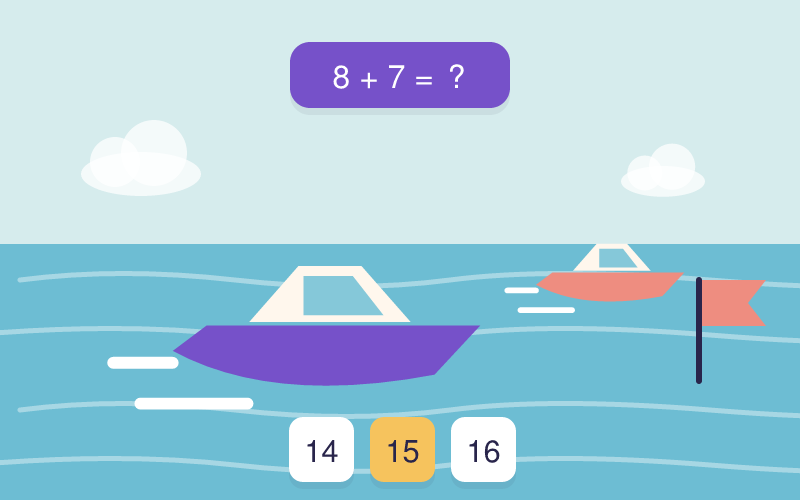
Tap the correct sum as each addition fact flashes on the wave track, and your jet ski surges toward the finish. The race rewards fast, accurate recall over slow recounting, so basic facts move from "can solve" to "answer on sight."
When Recounting Costs the Race: Speed Exposes Weak Fact Recall
Plenty of first and second graders reach the right answer to 8+6, but they get there by counting up from 8 on invisible fingers. That works on a worksheet and falls apart the moment a jet ski is closing on the finish line. Here each fact appears for only a beat before the next wave, so a slow recount visibly stalls the ski while a clean recall from memory pushes it forward. The tapping choice forces a commitment instead of a hedge, and the wave animation turns "too slow" into something the child can see rather than a grade they receive later. Over a round the high-frequency combinations repeat until retrieval, not recounting, becomes the default.
Grades 1-2: Turning Addition Within 20 Into Automatic Recall
By first grade, children already add within 20 by counting on and making ten (standard 1.OA.C.6); the finish-line pressure here nudges that same skill toward the effortless recall grade 2 expects under 2.OA.B.2. It builds on decomposing numbers to bridge ten, and it clears the runway for multi-digit and column addition, where one slow single-digit fact quietly becomes a bottleneck. Locking these sums into memory also hands second graders spare working memory for word problems and longer mental-math chains.
Three Addition Skills Practiced While the Jet Ski Accelerates
- Scan the equation before the next wave: connect the problem, answer choices, and result quickly enough for fact Fluency.
- Hold accuracy near the finish line: keep decisions steady when the race pace makes random tapping tempting.
- Retrieve high-frequency facts: repeated 8+6, 7+5, and 9+4-style combinations strengthen Number Sense and Mental Math recall.
Three Moves to the Finish Line: Read, Tap, Accelerate
- Start the race and watch for an addition fact within 20 to appear on screen.
- Click or tap the correct answer. A right answer sends the jet ski forward through the waves; a wrong tap slows the run.
- Keep answering until the race round ends at the finish line.
- For a stronger round, say the equation and answer aloud before tapping.
Five-Minute Teacher Routine: Use the Finish Line as a Recall Check
Do not track only who wins the race. Write down two or three facts the student misses on the wave track, then ask those exact facts after play. Faster answers away from the jet ski show that the race activated real addition Fluency.
Jet Ski Addition Questions Parents and Teachers Ask About Speed
Q: My student taps too fast during races. Should we avoid Jet Ski Addition?
A: Keep the race, but change the goal. Ask for five careful answers in a row instead of first place. The waves and finish line create useful pressure, but students should still read the equation before tapping. That habit turns the race from guessing into Mental Math practice.
Q: How can this work as a classroom warm-up?
A: Ask six target facts aloud first, often around 8-plus or 7-plus combinations. Then run one Jet Ski Addition round. Re-ask the same six facts afterward. Shorter pauses show that the race helped students retrieve the facts beyond the screen.