Dark Forest: Trace the Route Where Three Numbers Sum to the Target
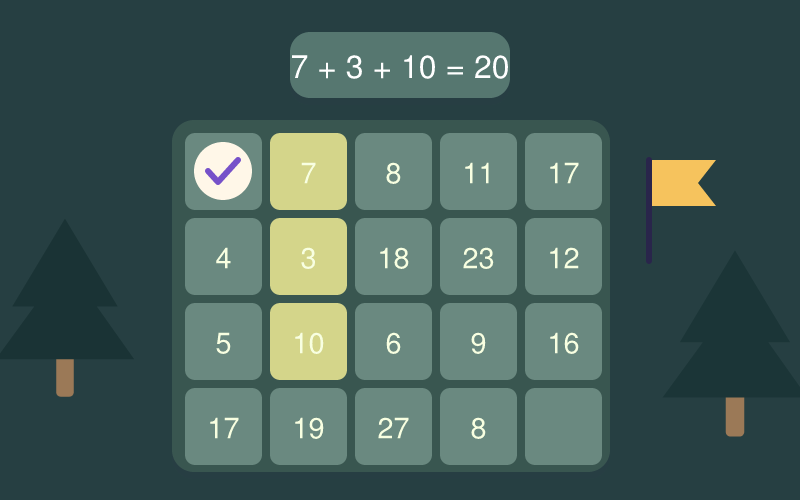
You move through an unlit grid, tapping only the tiles whose three numbers add up to the round's target so the safe path glows ahead. Each step trains you to test number combinations on purpose instead of stabbing at random.
How Do You Find the Triple That Hits the Target Without Losing Track of the Combinations You've Already Ruled Out?
Most fifth graders can add three numbers just fine, yet they freeze when a grid offers a dozen tiles and asks which triple lands on the target. The stall is combinatorial, not arithmetic: they test triples in no order and lose track of what they have already ruled out. Dark Forest fixes this by lighting a tile only when its three numbers hit the target, so a wrong tap stays dark and instantly signals the combination failed. That glow-or-nothing feedback nudges students to lock two numbers, ask how much more they need, and hunt the third on purpose. The unlit forest becomes a map of eliminated routes rather than a fog of random attempts.
Fluent Addition Becomes Target-Sum Search Strategy in Grades 5-6
Dark Forest assumes students are already fluent with multi-digit addition and stretches them toward writing and reasoning about expressions, matching CCSS 5.OA.A.2. The systematic combination search it builds is exactly the readiness 6.EE.B.6 expects when a letter stands in for an unknown number. Playing it bridges 'I can add' to 'I can search a solution space'—the leap from concrete arithmetic into early algebraic thinking.
Three Combination Skills Practiced While Lighting the Path
- Calculate the sum of three numbers.
- Filter possible combinations by using partial sums.
- Eliminate invalid routes instead of guessing randomly.
Three Moves to Light the Path: Read, Combine, Step
- Read the target sum for the round.
- Add the three numbers on a path tile.
- Step only where the three-number sum matches the target and explain any miss.
Five-Minute Teacher Routine: Use Lit Paths for Combination Explanations
Ask students to record one successful combination after play and explain why it works. Stating the logic helps the strategy stick.
Dark Forest Questions Teachers Ask About Random Guessing
Q: How can I reduce random combination testing?
A: Ask students to add two numbers first, then ask what third number is needed.
Q: Who should use this game?
A: Students who can add fluently but need stronger combination strategy. If three-number addition is slow, warm up first.