Chain Sums: Link Neighboring Numbers Until the Whole Path Hits the Target
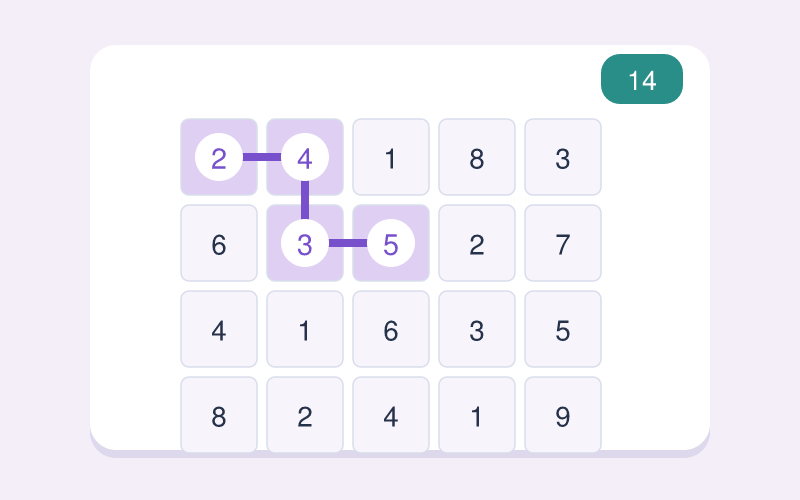
You drag from cell to cell, and each number you touch is added to a running total that must land exactly on the target. It trains multi-step mental addition and the habit of checking how far you still have to go before every move.
Numbers That Add Up Are Useless If They Aren't Neighbors
Drag from one cell to its neighbor and every value you touch piles onto a running total — yet the number that would perfectly finish your target often sits two cells away, with no legal path connecting to it. That adjacency rule is what trips learners up: a correct sum can be impossible to actually build. The drag path makes this constraint physical — you watch the running total climb cell by cell and feel the moment a tempting number sits one step too far away. When the total creeps close to the target, students learn to subtract ahead and ask what single value still fits, rather than grabbing the largest number in reach. If the chain overshoots, the path lights up as invalid, forcing a rethink of direction instead of a lucky guess. Over several rounds, the search shifts from random tapping to deliberate route-planning.
Multi-Addend Fluency Meets Path Planning in Grades 3-5
Chain Sums fits the moment students have secured single-step addition within 1,000 (3.NBT.A.2) while starting to combine several addends fluently. The running-total mechanic strengthens the mental-math strategies behind 4.NBT.B.4 and prepares learners to estimate and check whether a sum is reasonable (3.OA.D.8) before they move into multi-step problem solving. By treating each move as "target minus running total," students rehearse the inverse relationship between addition and subtraction that later underpins algebraic thinking.
Three Skills Practiced in Chain Sums
- mental addition across several addends
- using the remaining difference to choose a value
- searching adjacent cells for a valid path
Teacher and Parent Note
Have the student say the running total and the amount still needed after each selection. After the round, compare two different paths that reach the same target with different values.