Scientific Notation Blast: Catch the Meteor Whose Power of Ten Fits the Number
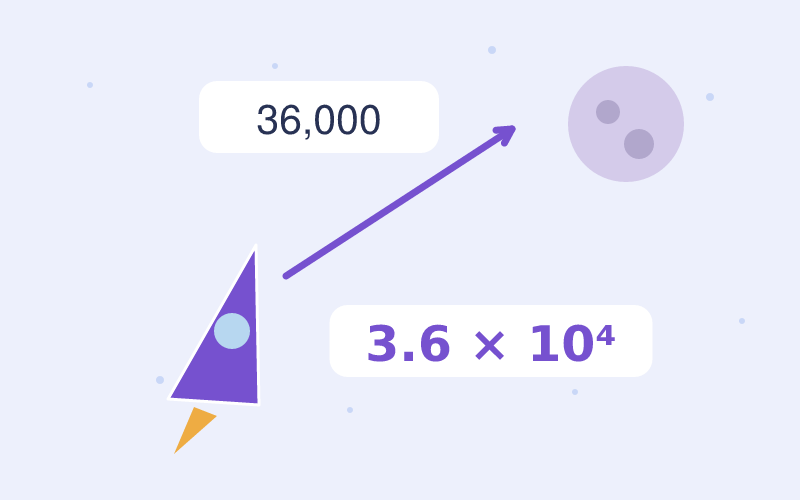
Steer a rocket basket left and right to catch the a×10ⁿ meteor that matches each standard number streaking down the screen. Every catch forces a quick decision about the coefficient's range and how many places the decimal has to travel.
Counting Zeros Isn't Counting Moves: Where the Exponent Actually Comes From
Most Grade 8 students can recite that scientific notation needs a coefficient between 1 and 10, yet they still write 4.5×10⁵ for 4,500,000 because they counted the zeros instead of the decimal-place moves. Scientific Notation Blast puts that exact slip on the clock: as a meteor falls, you rewrite the number in your head, place the decimal after the first nonzero digit, and tally each hop it makes. Only the meteor carrying the correct power-of-ten tag fits the target, so a miscount sends the rocket basket into the wrong lane. Because the falling meteors also show competing exponents, the game trains you to check the coefficient range first, then confirm the move count — the two-step habit that stops magnitude errors before they start.
Grade 8: Linking Exponents to the Size of a Number
Scientific Notation Blast fits Grade 8, where powers of ten stop being a formatting rule and become a way to gauge magnitude. It builds on earlier place-value and integer-exponent work (8.EE.A.1) and prepares students to express and compare very large and very small quantities, matching CCSS 8.EE.A.3 and 8.EE.A.4. Mastering the decimal-move count here sets up later fluency with unit prefixes, estimation, and rational-number magnitude in science and algebra.
Three Scientific-Notation Skills Practiced While Catching Meteors
- Convert large whole numbers into a×10^n form with a coefficient from 1 up to 10.
- Determine the exponent by counting decimal-place movement.
- Compare magnitudes quickly by reading powers of ten.
Three Moves to Catch: Read, Count, Match
- Read the target number and locate the first nonzero digit.
- Move the decimal so the coefficient is at least 1 and less than 10.
- Count how many places the decimal moved to choose the power-of-ten tag.
- Move the rocket basket to catch the matching notation and avoid wrong exponents.
Five-Minute Teacher Routine: Draw the Decimal-Move Arrow
Use 4500000, write 4.5, then draw arrows showing 6 places of movement before writing 4.5×10^6. The visible movement reduces exponent errors during play.
Scientific Notation Blast Questions Teachers Hear
Q: Why does my student write a coefficient like 12.3?
A: The coefficient must be at least 1 and less than 10. Check the coefficient range first, then check the exponent.
Q: Why is the exponent 5 instead of 6?
A: The exponent counts decimal-place moves, not simply zeros. Drawing arrows from the original decimal point makes the count visible.