Angle Measure Lab: Read the Vertex Ray and Name Its Degree Measure
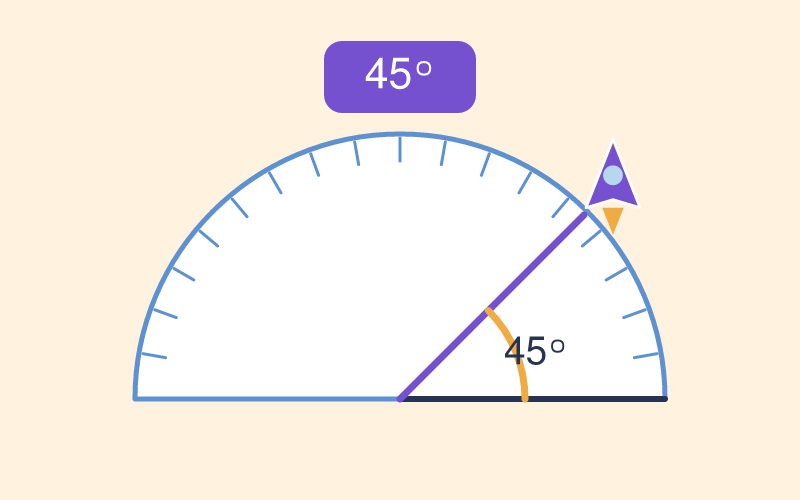
Read the semicircle scale and choose the angle from four options.
Which Side Is Zero? Where 60 and 120 Degrees Trade Places
Read the semicircle scale and choose the angle from four options. Targets range from 10° to 170° in 5° steps and avoid recent target values.
From “Angles as Rotation” to Confident Protractor Measuring in Grade 4–5
Reading a rocket ray as 45, 90, or 135 degrees turns the idea of an angle as a fraction of a full turn (CCSS 4.MD.C.5) into the hands-on reading practice behind measuring with a protractor (CCSS 4.MD.C.6). Those locked-in benchmark angles then feed the additive angle work of CCSS 4.MD.C.7 and the coordinate and figure reasoning that follows in Grade 5.
Three Measurement Skills Practiced While Reading Angle Measure Lab
- Locate the vertex and baseline before reading the angle.
- Recognize benchmark degrees such as 45, 90, and 135.
- Choose the correct measure from nearby options while avoiding reversed readings.
Three Moves to Read the Angle: Vertex, Ray, Degree
- Find the vertex and horizontal baseline first.
- Look at how far the rocket ray rotates from the baseline.
- Compare the angle with benchmark degrees.
- Choose the degree option and use feedback to catch reversed readings.
Five-Minute Teacher Routine: Name Vertex and Baseline First
Before each answer, have students say where the vertex is and which ray is the 0-degree side. That habit prevents most reversed readings.
Angle Measure Lab Questions Teachers Hear
Q: Why does my student confuse 60 and 120 degrees?
A: They may not first decide whether the angle is acute or obtuse. Ask whether the angle is less than or greater than 90 before choosing.
Q: Can this work without a physical protractor?
A: Yes for reading and benchmark practice. Pair it with a real protractor later for center-and-scale alignment.