Hundred Chart Hunt: Track Hundreds-Chart Clues to Locate Hidden Numbers
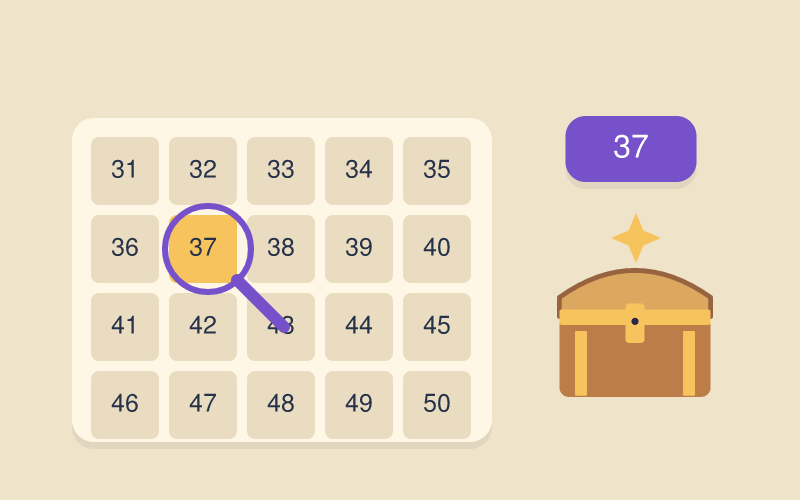
Use fresh range, multiple, place-value, and arithmetic clues to find numbers on the 1–100 chart.
Up One Row Isn't Up One: Why the Hundreds Chart Hides a Jump of Ten
Use fresh range, multiple, place-value, and arithmetic clues to find numbers on the 1–100 chart. A clue may accept several numbers; every matching value remains valid. Replay generates new clues.
From Reading Numbers to Walking Them: Two-Digit Sense for Grade 2-3
Hundred Chart Hunt lands once children can read and write two-digit numbers, right before they add and subtract within 100 by regrouping. Locating numbers on the chart (CCSS 2.NBT.A.1) and using +1, -1, +10, and -10 moves (CCSS 2.NBT.A.2) lays the spatial groundwork for grade-3 mental addition. Students leave with a number map they can walk in their head.
Three Place-Value Skills Practiced While Finding Treasure Squares
- Translate range, multiple, digit, and arithmetic clues into predicates
- Locate a number satisfying every condition on the 1–100 chart
- Recognize that one clue may have several legal answers
Three Moves to Find the Treasure: Read, Move, Confirm
- Read all conditions and identify the required range or mathematical property.
- Click any number on the 1–100 chart that satisfies every condition.
- Review the feedback and highlighted accepted numbers, then continue. Replay gives a fresh clue set.
Five-Minute Teacher Routine: Turn Direction Clues Into Place-Value Talk
Have students mark a few numbers on a paper hundreds chart before they play and discuss the numbers around them. That quick preview strengthens chart reasoning on screen.
Hundred Chart Hunt Questions Teachers Ask About Chart Navigation
Q: Why can my student read the number but not find it?
A: Reading and locating are different skills. Start from a nearby multiple of ten, then count across the row.
Q: Why are up and down moves confusing?
A: The tens-place pattern is still developing. Compare numbers in one column, such as 23, 33, and 43, to show the +10 pattern.